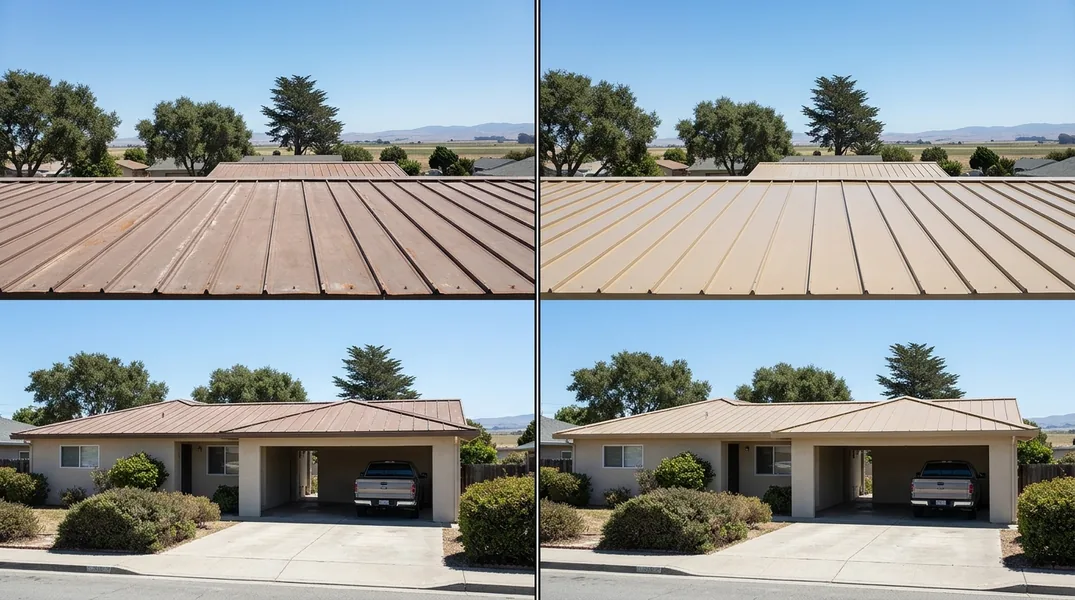
Why Salinas Valley Wind Is Harder on Roofs Than You Might Think
When people think about wind damage, they usually picture coastal storms or hurricane country. But the Salinas Valley has its own wind personality, and it is not gentle. On a typical spring or summer afternoon, the valley floor funnels cool marine air inland, and that pressure difference turns into a steady, sometimes gusty wind that pushes across rooftops for hours at a time. It is not a single dramatic gust that causes problems. It is the relentless, day after day load that slowly works on weak fasteners, loose panels, and aging shingles.
This matters for homeowners because wind does not just tear things off. It gets underneath edges and lifts. It rattles fasteners loose over months and years, opening tiny gaps where water can sneak in later. An asphalt shingle roof that looked fine five years ago can start showing lifted tabs and missing pieces after enough seasons of valley wind. That is exactly the kind of slow wear that makes wind resistant roofing a real conversation here, not just a marketing phrase. If you have noticed granules in your gutters or shingles flapping at the corners, it is worth getting a professional opinion before the next windy season.
How Metal Roofs Resist Wind Uplift
Metal roof wind uplift is the technical term for the force that tries to peel a roof off a house when wind flows over and around it. As air moves faster over the roof surface, pressure drops above the panels, and the relatively higher pressure underneath pushes up. The result is a lifting force that is strongest at the edges, corners, and ridge. Metal roofs handle this differently than shingles because the panels are continuous, interlocking, and mechanically attached rather than glued down with sealant strips. A properly installed metal roof creates a single, stiff surface that spreads wind load across the whole assembly instead of letting it concentrate at a few weak points.
The key word there is properly. A metal roof that is under-fastened or installed with the wrong clip spacing can still fail in high wind, which is why the installation details matter more than the material itself. Standing Seam Metal Roofing is especially strong in this regard because the panels are joined with raised seams and hidden fasteners, so there are no exposed screws for wind to grab or for water to work around. The panels are held by concealed clips that allow for thermal movement while keeping the roof locked down. That combination of continuous panels and hidden attachment is a big part of why standing seam is a popular choice in windy agricultural valleys like ours.
Standing Seam Wind Ratings: What the Numbers Actually Mean
You will often see standing seam wind rating numbers quoted in product literature, and they can sound impressive, but it helps to understand what they represent. Wind ratings for metal roofing are typically expressed as design pressures in pounds per square foot, and they are established through testing that simulates uplift. The rating depends on panel profile, metal thickness, clip spacing, and how the roof is attached to the deck and structure. A high rating on a brochure means the panel passed a test under specific conditions. It does not automatically mean your roof will perform the same way if the installer cuts corners on clip spacing or skips the structural screws that tie the roof to the framing.
For a homeowner, the practical takeaway is this: ask your installer how the roof will be fastened, not just what panel is being used. In the Salinas Valley, where wind is a daily factor rather than a rare event, a roof that is engineered and installed for local conditions will outperform a generic installation every time. A reputable contractor will be able to explain clip spacing, fastener type, and how the roof edges and ridge are secured, because those are the areas where wind uplift concentrates. If someone cannot answer those questions clearly, that is a red flag worth paying attention to.
Metal Roof Fasteners: The Small Parts That Do the Heavy Lifting
It is easy to focus on the big shiny panels and forget that metal roof fasteners are what actually hold everything together. There are two broad categories to know about. Exposed fasteners are screws with washers that go through the panel and into the structure, common on corrugated and some panel systems. Concealed fasteners are used with standing seam and similar systems, where clips or plates are fastened to the deck and the panel snaps or locks over them. Both can perform well, but they fail differently. Exposed screws can back out over time, and the washer can degrade, which is why they need to be driven to the correct depth and checked periodically. Concealed systems avoid that problem but depend entirely on correct clip installation.
In a windy place like Boronda, the quality of the fastener matters as much as the quantity. Stainless or coated fasteners resist corrosion, which is important because a rusted screw loses holding power. The fastener must also match the deck material, whether that is wood sheathing or an existing roof structure. And the spacing has to match the engineering for the wind zone, not just what is convenient. This is one of those areas where a few cents saved per screw can cost a homeowner much more down the road. A proper Metal Roof Installation accounts for all of this before the first panel goes up.
Metal Roof Installation Near Me: When to Call a Pro
If you are searching for metal roof installation near me in the Salinas area, you are probably weighing a few things: the age of your current roof, how it has held up to wind, and whether it is time to upgrade. A good rule of thumb is that if you are seeing lifted shingles, exposed nails, or granules collecting in gutters after windy stretches, the roof is telling you something. It is also worth calling a professional if you are planning a Metal Roof Replacement and want to make sure the new roof is engineered for local wind rather than installed with generic assumptions. Some homeowners also ask about a Metal Roof Over Shingles (Retrofit), which can be a practical option, but the wind fastening details still have to be handled correctly for the assembly to perform.
A local installer who works in the Salinas Valley regularly will understand the wind patterns, the typical deck conditions, and the inspection requirements in the area. That local knowledge is hard to replace. If you are in Spreckels or Castroville, the same principles apply: the roof needs to be fastened for the wind it will actually see, not for a national average. Getting a professional assessment early is almost always cheaper than repairing wind damage later. You can call Salinas Metal Roofing at (831) 484-7891 to talk through your situation, or request a free estimate to get a clear picture of what your roof needs.
What to Ask Before You Choose a Metal Roof
Before you commit to any roofing project, ask a few direct questions. How will the panels be fastened, and what is the clip or screw spacing? How are the edges, ridge, and corners secured, since those are the high wind uplift zones? What is the wind rating of the specific assembly being proposed, and does it account for the local conditions? What kind of fasteners are being used, and are they corrosion resistant? A contractor who can answer these without hesitation is likely doing the job right. One who brushes them off is not. It also helps to ask about pricing up front so you understand what is included in the fastening and engineering details rather than discovering add-ons later.
Finally, remember that a metal roof is a long term investment, and the wind performance you get is the result of many small decisions made during installation. The panel brand matters, but the fastening plan, the deck preparation, and the attention to edges matter just as much. In a valley where the wind shows up almost every afternoon, that attention to detail is what separates a roof that lasts decades from one that keeps you calling for repairs. If you want a roof that is genuinely built for Salinas Valley wind, the right place to start is a conversation with a local professional who installs metal roofs every week.
Looking for a professional metal roofing contractor in Salinas? Salinas Metal Roofing responds fast for all your metal roofing needs.
Get a Free QuoteOur services: Metal Roof Installation · Standing Seam Metal Roofing · Metal Roof Replacement